Latest Event Updates
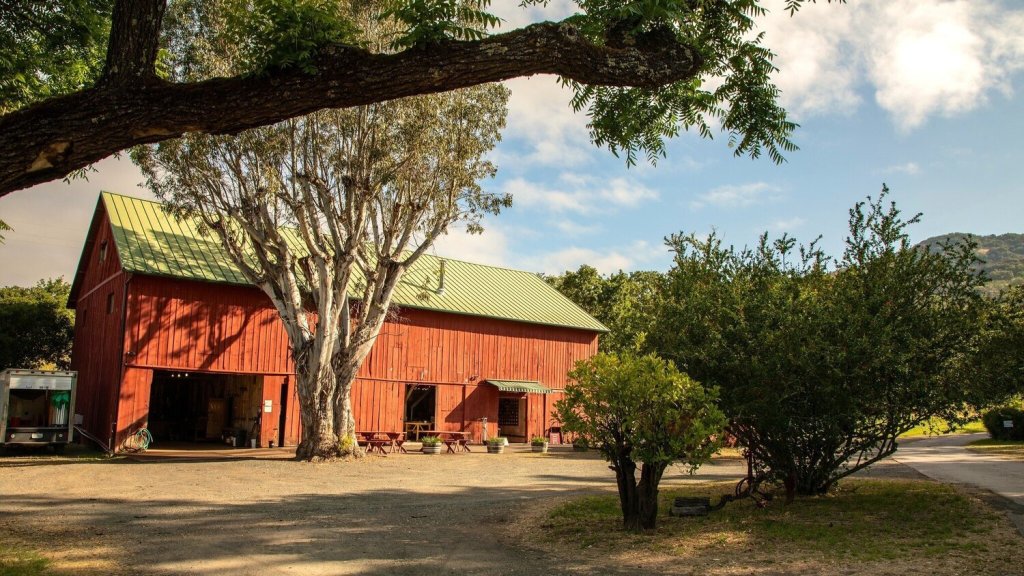
Know Your Farmer: Oak Hill Farm
Happy 2025!
This is the first in a series of articles on our local farms focusing on those committed to feeding Sonomans on a large scale.
The first on the list is one of the oldest Sonoma Valley farms, a staple selling staples, amongst other great products. I recently caught up with Melissa Bucklin, current head Farmer at Oak Hill alongside her partner Jimi Good.
How long has Oak Hill been in business?
“Around 50 years. Otto Teller began the farm business by selling floral “backing greens” (myrtle, eucalyptus, magnolia) to a wholesaler in New York. Over the years the business shifted to the San Francisco Flower Market, and when Otto married Anne Teller (late 80’s), the farm began to grow vegetables and fruits, particularly under the expert guidance of Paul Wirtz in the early 2000’s. The farm has slowly but surely shifted away from the wholesale flower business into produce and retail focus.”
How many acres do you farm?
“We actively farm 10-12 acres of row crops and orchard, plus 10-20 acres of grazing pasture for cattle and a few pockets of perennial greens tucked around the property.”
Much of your property is has been protected by conservation easements, what is the background on that?
“The Oak Hill Farm property was the first property to be protected by the Sonoma Land Trust, and Otto and Anne Teller were instrumental in the establishment of the Sonoma Land Trust.”
What types of crops do you grow and sell?
“We grow a wide range of vegetables and fruits, and some flowers. Top crops include: potatoes, tomatoes, peppers, brassicas (cabbage, kale, broccoli, cauliflower, brussels sprouts), lettuce, onions, garlic, carrots, winter squash, sunflowers, eucalyptus. We also have a small herd of beef cattle and a small flock of laying hens.”
Where do you sell them?
“We mostly sell our products through our on-site farmstand in our historic dairy barn, and at the Sonoma Valley Farmers Market on Fridays. We also sell to several local restaurants, grocery stores, and florists.”
What are the benefits of farming in Sonoma Valley?
“Our mild climate allows us to grow a wide range of crops without using plastic field houses and plastic mulch, and allows us to be in production year-round. This provides steady, year-round work for our staff. We have a very supportive community and growing interest in high-quality food.”
What are the challenges of farming in Sonoma Valley?
“The climate can be challenging – we worry about water availability, fire is a constant threat in our heavily wooded property. Wildlife pressure is intense, and we have little means of excluding them. Cost of living is very high, which makes it difficult for a low-margin business like ours to pay our staff enough to live here. The agricultural focus in this area is all about vineyards, and nearby row crop agriculture is mostly large-scale monoculture, making it difficult to source appropriate equipment and supplies.”
What are your favorite crops to grow and eat/use?
“Potatoes! Cabbage! Hot Peppers! Beef!”
9. How can Sonoma Valley become more sustainable with regards to local food production?
“First and foremost: Grow more food! There is plenty of demand, but not enough production in Sonoma County. Local citizens should engage with local farmers to truly understand the source and growing practices that produce their food. Large Central Valley farmers bring produce to Sonoma County and call themselves “local farmers”. Government can help promote and support food producers, not just wine and grape producers, and support all Certified Farmers Markets. The government can subsidize and encourage well water use on food crops. Governments could increase funding for the purchase of local food products for food banks, schools, and other public institutions. If the government put more money into affordable housing projects, it would make life better for all, including farmworkers. Farm subsidies should be distributed to all farms, not just large monocrop commodity farms.”
Any other thoughts or points you would like to make?
“Eat seasonal! Buy local! Grow a garden if you can, and support a local farmer if you can’t!”
(Seth Dolinsky is Lecturer of Sonoma Valley Grange, whose motto is: Healthy Farms, Healthy Food, Healthy Community, and is owner of New Land Systems, a regenerative land management company.)
Cold Comfort Farmer
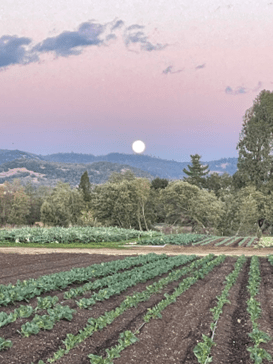
This article was recently published in the Sonoma Sun newspaper highlighting our venerable local farm Pauls Produce:
Change is in the air. Not only on the national geopolitical level, but here at home, in the Sonoma Valley we have seen the clear end of one season and the transition to the next. Sonomans will tell you, historically “It always rains on Halloween” – or around then. Sure enough, the wet season has begun, and with it, cooler temperatures. Catching up with Farmer Paul Wirtz over at Paul’s Produce Farm on Arnold Drive, we discussed the year that was and the winter growing season ahead.
Driving out to meet Paul at the tractor barn, I marveled at the clean rows of newly planted crops, lettuces, brassicas (broccoli, cauliflower, cabbage etc.), herbs, carrots and beets, radish, and more. Summer crops were long gone, tilled in to provide nutrients for the next go-round. I sought Paul’s take on the year that was.
How was the 2024 growing season? I asked. “Good. Weather wise it was one of the easiest years. We started off wet, and were late in planting Spring crops. After that, we had great growing conditions, no major heat spells which leads to greater success in planting seeds and starts.”
“We also have a great crew this year, including full time employees but also extra help in the greenhouse and in sales”
How has the preparation for fall and winter gone so far?
“We are caught up. We try not to overdue summer and move early into fall preparations. We make most of our own compost on-site, and compost each bed prior to planting, and save some of these beds for use in the wet season, when we are not able to take the tractor out on the fields”. “We will do some seeding and planting into year end, mostly lettuces, peas and cool season crops, with the majority of starts coming from the greenhouse. One of the tricks in farming year-round is keeping work for employees in the winter season.”
Anything new to the farm?
“Well not exactly new, but our Farm Manager Cody Curtis who came on a few years back has done a great job at overseeing our operations. Having people who are interested and love the work makes a huge difference.”
What is coming to market for the Holiday Season?
“Lots of variety. Carrots, beets, winter squash, onions, leeks, greens, parsnips, turnips, radish, arugula, celery, broccoli – and more. We will be at the Farmer’s Market at Depot Park Tuesday the 26th 9:am – 12:30am pre-Thanksgiving.”
Where can folks find Paul’s Produce?
“We sell retail at the Friday Farmer’s market, Sonoma Market, who have been a great customer, and through the FEED bin from FEED Sonoma, a farmers cooperative distributor.” “FEED has also been able to win grants for essential food distributions including through Food For All/Comida Para Todos here in the Valley”.
I replied: “That’s right! I remember us at the Grange starting the vegetable contribution to that distribution during the pandemic, we are glad to hear it continues and is funded!”
The fact is, Sonoma Valley, once a breadbasket to the Bay Area now has very little local food production. Those that continue, such as Paul, are truly working to keep our Valley sustainable. Supporting local farms preserves the rural character of our community, creates economic diversity, provides nutritious and flavorful foods, and provides inspiration in the kitchen during the cold winter months – true Cold Comfort!
(Seth Dolinsky is Lecturer at Sonoma Valley Grange, A 100 year-old Valley service organization supporting local farms and food producers, and is owner of New Land Systems, a regenerative land management company.)
Sonoma Friday Farmer’s Market

Spring Farmers Market Review
The Sonoma Friday Farmers’ Market at Depot Park is a Sonoma tradition that spans over 35 years. This outdoor event, set in the parking lot for Arnold Field, is the main source for Sonoma Valley folks to meet and shop with their local farmers and food producers. Running year-round Fridays from 9:00am – 12:30pm, these few hours afford us the opportunity for some of the best food available. A recent shopping trip provided a glimpse of what bounty the Spring season has to offer.
The lines were already forming at 9:00am from eager shoppers looking to beat the crowds (and perhaps score some of the limited specialty crops and items found here). I started at Mike the Bejkr’s booth, our local celebrity baker, known for using ancient grains, local ingredients, and always organic. Today the counters were brimming with baked goods – decisions, decisions! Fresh pretzels were coming out of the wood-fired oven, an easy first choice. Then for the sweet – ginger scones and the millet-hazelnut financier were the hard choices out of at least half a dozen. A large pan loaf of the Einkorn bread, made with one of the oldest cultivated wheats topped off my basket – and my bread budget!
Moving on down the line, Hector’s Honey has a large array of farm products – honey, beeswax candles, garlic, citrus, asparagus, and more. Ortiz Family Farm from Santa Rosa has big butter lettuces, kale, chard, beets and some nice tulips and daffodils. Speaking of flowers, Oak Hill Farm of Glen Ellen, one of the markets founding vendors, had fragrant white and purple lilac, pastel colored ranunculus, pink tea-tree and lots of carrots, celery root, potatoes (including the fabled Bodega Red!), chard, arugula, lettuces, shallots, radishes and fava greens. Rhodes Family Farm coming from the central valley had spring onions, carrots, green garlic, cauliflower, broccoli, citrus and avocados, and, amazingly, zucchini! Farms coming from out of the valley, though not technically local, do bring in other items not available, though some would say we can work to produce more locally, but avocados are a stretch! Rojas farms is another that brings a large variety of citrus, grapefruits, navel oranges and mandarins.
Paul’s Produce, another of the mainstays of Sonoma agriculture, had a line 20 people deep and growing. Folks came for their famous salad mix, carrots, beet greens, kales, cilantro, brussels sprouts, asparagus, artichokes, leeks, and staple storage crops like butternut squash, onion and shallots. Next door were free-range eggs by-the-dozen from Opal Moon Farm, with neighboring booth Sweetwater Spectrum bringing their fresh sprouts of all varieties grown right in city limits. Iconic Sonoma County dairy Strauss Creamery is onsite for all of your organic dairy needs, and Sonoma County Meat company providing locally raised meat – chicken, pork and beef. Rounding out these offerings are incredible edible and medicinal mushrooms from Bohemian Well Being Farm, the Hummus Guy with many varieties of hummus and mediterranean fare, baked goods from Baker and Cook, smoked salmon and seafood, roasted and pour over coffee and crepes.
All told, the Spring Farmers’ Market has everything we need for a well-rounded diet, providing opportunity for small local producers to sell direct and increase business viability and sustainability, all while offering us Valley residents some of the best things in life.
(Seth Dolinsky is Lecturer of Sonoma Valley Grange, whose motto is: Healthy Farms, Healthy Food, Healthy Community, and is owner of New Land Systems, a regenerative land management company.)
- ← Previous
- 1
- 2
- 3
- …
- 23
- Next →
 Sonoma Valley Grange #407